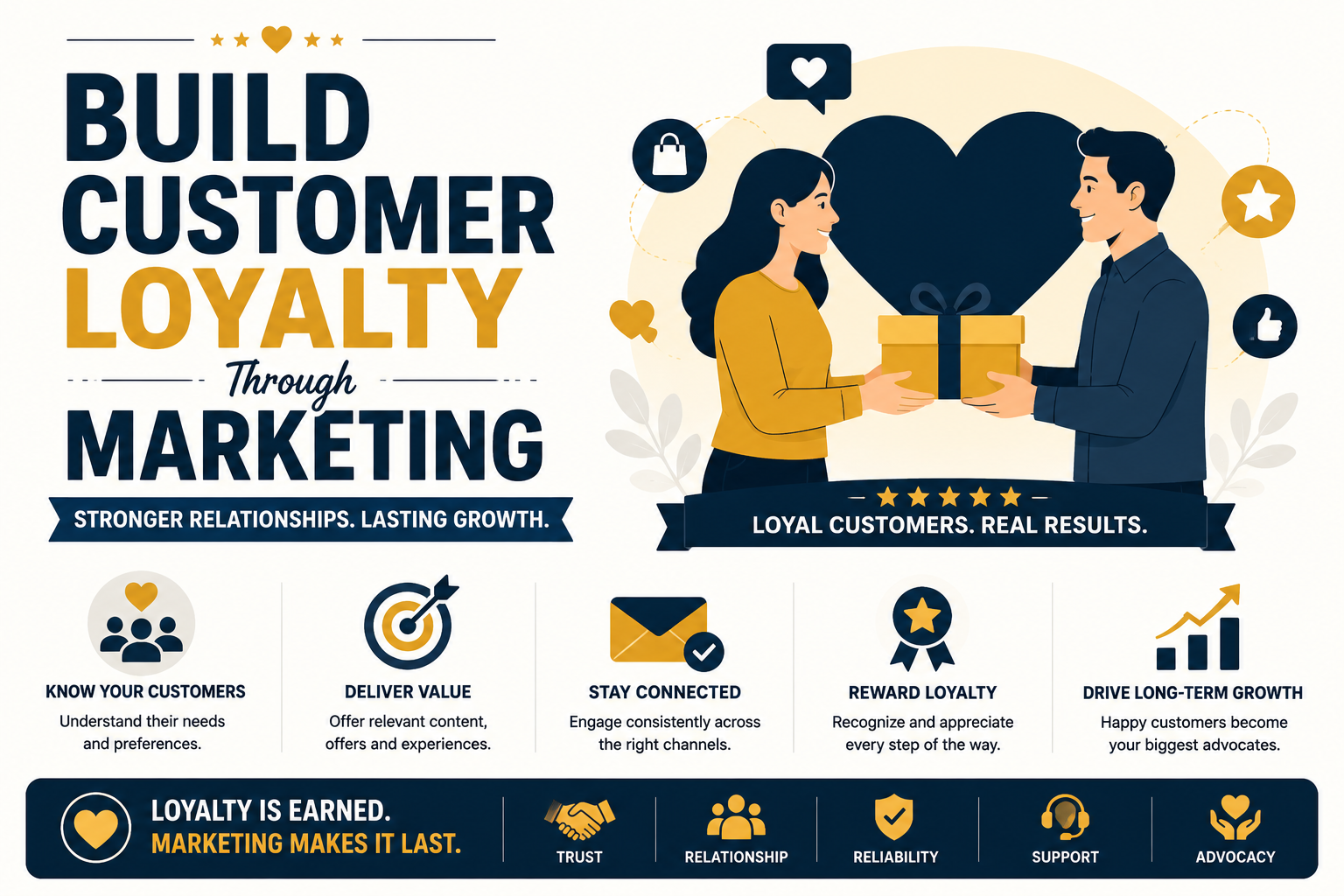
If your customer retention strategy begins and ends with "10% off your next order," you don't have loyal customers — you have people waiting for the next coupon. Building customer loyalty through marketing means giving people a reason to come back that has nothing to do with price, because the moment a competitor undercuts your discount, that relationship evaporates. Discounts are rented attention; loyalty is owned. U.S. consumers today have more brand options than at any point in retail history, and the businesses winning long-term aren't the ones with the deepest markdowns — they're the ones customers actually trust. This guide breaks down how to build that trust through marketing, not margin erosion.
Why Discounts Train Customers to Wait, Not Return
Every time you run a sitewide discount, you're teaching your audience a lesson — just not the one you intended. The lesson is: don't buy at full price, because a better deal is always around the corner. This is the retail equivalent of negotiating with a toddler over bedtime; give in once and the conversation is over before it starts. Research from U.S. retail behavior studies consistently shows that discount-driven customers have lower lifetime value and higher price sensitivity than customers acquired through brand affinity or content. They're shopping the promotion, not the brand.
There's also a compounding cost problem. Every discount trains your margin down while training customer expectations up, and once that expectation is set, reversing it is expensive — both financially and in terms of brand perception. A business that discounts constantly starts to look like it's always on sale, which, ironically, makes customers trust the "regular" price less. It's a race to the bottom, and the finish line is a business that can no longer afford to compete on anything but price.
None of this means promotions are inherently bad. A well-timed, limited offer can drive urgency. The problem is using discounts as the entire loyalty strategy instead of one small tool inside a much bigger toolbox. Our guide to building a marketing budget that doesn't waste money is a good place to start if your current plan is "discount and hope."

Real loyalty looks more like a handshake than a coupon code.
The Real Psychology of Loyalty: Value, Trust, and Recognition
Loyalty is an emotional transaction disguised as a rational one. Customers tell themselves they stick with a brand because of price or convenience, but the underlying driver is almost always some combination of trust, recognition, and identity. People don't feel loyal to a spreadsheet; they feel loyal to brands that make them feel understood.
Emotional Loyalty vs. Transactional Loyalty
Transactional loyalty exists only as long as the deal does. Emotional loyalty survives a price increase, a competitor's flashy ad campaign, and even the occasional service hiccup, because the customer has already decided you're "their" brand. Marketing's job is to shift as many customers as possible from the transactional column into the emotional one — and that shift happens through consistency, communication, and small moments of surprise that a discount code could never replicate.
What Actually Drives Loyalty for U.S. Consumers
Across surveys of American shoppers, the recurring themes aren't "lowest price." They're things like: being treated well when something goes wrong, feeling like the brand remembers who they are, and consistent quality they don't have to second-guess. A customer who gets a thoughtful, human response to a complaint often becomes more loyal than one who never had a problem at all — which is either great news or deeply unfair, depending on how your last support ticket went.
Marketing Strategies That Build Loyalty Without Cutting Prices

Loyalty is built in the small, repeated moments — not the big markdown.
Personalized Email and SMS Marketing
Generic blast emails read like they were written for no one in particular, because they were. Segmented, behavior-triggered email and SMS — based on purchase history, browsing behavior, or milestones like a customer's sign-up anniversary — makes people feel seen instead of spammed. This is also one of the highest-ROI channels available; email marketing regularly outperforms paid social on cost-per-retained-customer. If your list still gets one identical email a week, our email marketing 101 guide for small business walks through building a list that actually converts instead of unsubscribing en masse.
Content Marketing That Builds Trust Before the Sale
Educational content — guides, how-tos, comparison breakdowns — positions your brand as a resource rather than a vendor, and resources get bookmarked, not ignored. When a customer solves a real problem using your content, they associate that relief with your brand, long before they ever check out. This is a slower play than a flash sale, sure, but it compounds; a sale ends at midnight, a good guide keeps working for years. Content strategy vs. content marketing breaks down how to plan this without just producing content for content's sake.
Community and Social Proof
Humans are herd animals with better haircuts, and social proof works because of it. Reviews, user-generated content, and active community spaces (private Facebook groups, branded Discord servers, loyalty-only forums) turn customers into advocates. When someone posts about your product unprompted, that carries more weight than any ad you could run, largely because nobody suspects their cousin's Instagram story of being sponsored content.
Exceptional Support as a Marketing Channel
Customer support is usually filed under "operations," but every support interaction is a marketing touchpoint whether you plan for it or not. A fast, human, no-nonsense resolution to a problem does more for retention than a 20%-off banner ever will, and it costs less than you'd think to get this right consistently. Brands that treat support like an afterthought are, functionally, marketing against themselves.
A Quick Gut-Check
If your last three "loyalty initiatives" were all price-based, that's not a loyalty program — that's a discounting habit wearing a loyalty program's clothes.
Loyalty Program Models That Aren't About Money Off

The best loyalty programs are designed around behavior data, not blanket discounts.
Not every loyalty mechanism has to touch price. Here's how the most common non-discount models stack up:
| Program Type | What It Rewards | Best For | Discount-Dependent? |
|---|---|---|---|
| Tiered Access | Loyalty duration / spend history | Subscription & membership brands | No — rewards early access, not price |
| Referral Programs | Advocacy and word-of-mouth | B2C and service businesses | Optional — can reward with credit or perks |
| Experiential Rewards | Engagement (events, previews, swag) | Community-driven and lifestyle brands | No |
| Points-for-Perks | Purchase frequency | Retail and e-commerce | Sometimes — depends on redemption design |
| Straight Discount Codes | Price sensitivity | Short-term revenue pushes only | Entirely |
Notice a pattern: the strongest loyalty models reward behavior and time, not just spend. A customer who gets early access to a new product line, an invite to a members-only event, or genuine public recognition for their loyalty tends to stick around longer than one who's simply accumulating 5% off coupons. If you're weighing which structure fits your growth stage, Purple Startups' growth strategy resources are a useful outside reference for how early-stage companies sequence retention tactics against acquisition spend.
Measuring Loyalty: Metrics That Matter More Than Coupons Redeemed
If the only number you're tracking is "discount redemption rate," you're measuring how good your customers are at finding coupons, not how loyal they are to your brand. Shift attention to metrics that actually reflect relationship strength:
- Repeat purchase rate over a 90 / 180 / 365-day window
- Customer Lifetime Value (CLV) trend, not just total revenue
- Net Promoter Score (NPS) and how it moves after support interactions
- Email and SMS engagement rate (opens, clicks, replies) segmented by tenure
- Referral rate — how many new customers arrive because an existing one told them to
- Churn rate by cohort, especially the first-90-day cohort where most churn happens
Businesses that track these instead of coupon math tend to make better marketing decisions, because they're optimizing for the relationship instead of the transaction. It's the difference between asking "did this sale move units?" and asking "did this customer come back without one?"
How Devtaastic Builds Loyalty-Driven Marketing for U.S. Businesses
Building a loyalty engine that doesn't rely on discounting takes coordinated work across email, content, branding, and site experience — which is exactly the overlap where most in-house marketing teams run out of bandwidth. Devtaastic works with U.S. small and mid-sized businesses to build the pieces that actually move retention: digital marketing services covering segmented email flows, content strategy, and social proof systems, paired with brand strategy guidance so your brand identity and your marketing motion are actually saying the same thing. A confused brand voice is its own kind of churn risk.
The goal isn't a one-time campaign; it's a system that keeps earning repeat business long after the launch excitement fades — the marketing equivalent of a slow-release capsule instead of a sugar rush.
Frequently Asked Questions
Does building customer loyalty through marketing really work better than discounts?
Yes, for long-term value. Discounts can drive a short-term revenue bump, but customers acquired or retained primarily through discounting tend to have lower lifetime value and churn faster once the offer disappears. Loyalty built on trust, personalization, and consistent experience holds up even when a competitor undercuts your price.
How long does it take to see results from a non-discount loyalty strategy?
Most businesses start seeing measurable shifts in repeat purchase rate and email engagement within 60 to 90 days of implementing segmented communication and content strategy, though full loyalty program maturity (referrals, tiered perks) typically takes two to three quarters to show its full financial impact.
Can small businesses with limited marketing budgets still build real loyalty?
Absolutely, and in some ways small businesses have an advantage — personalization is easier at a smaller scale. Segmented email, prompt customer support, and consistent content are all lower-cost than an ongoing discount strategy, and they scale in effectiveness as the customer base grows.
What's the biggest mistake businesses make with loyalty programs?
Treating the loyalty program as a discount delivery mechanism instead of a relationship-building system. If every reward is a percentage off, the program trains price sensitivity rather than brand affinity, and customers end up loyal to the discount, not the business.
Should I completely eliminate discounts from my marketing strategy?
No — discounts still have a place for specific goals like clearing inventory or driving urgency around a launch. The issue is relying on them as the primary loyalty mechanism. Used sparingly and strategically, discounts can complement a broader loyalty strategy without undermining it.
Ready to Build a Loyalty Strategy That Doesn't Rely on Discounts?
Devtaastic helps U.S. businesses design email, content, and retention systems that keep customers coming back — without racing competitors to the bottom on price.
Get a Free Quote