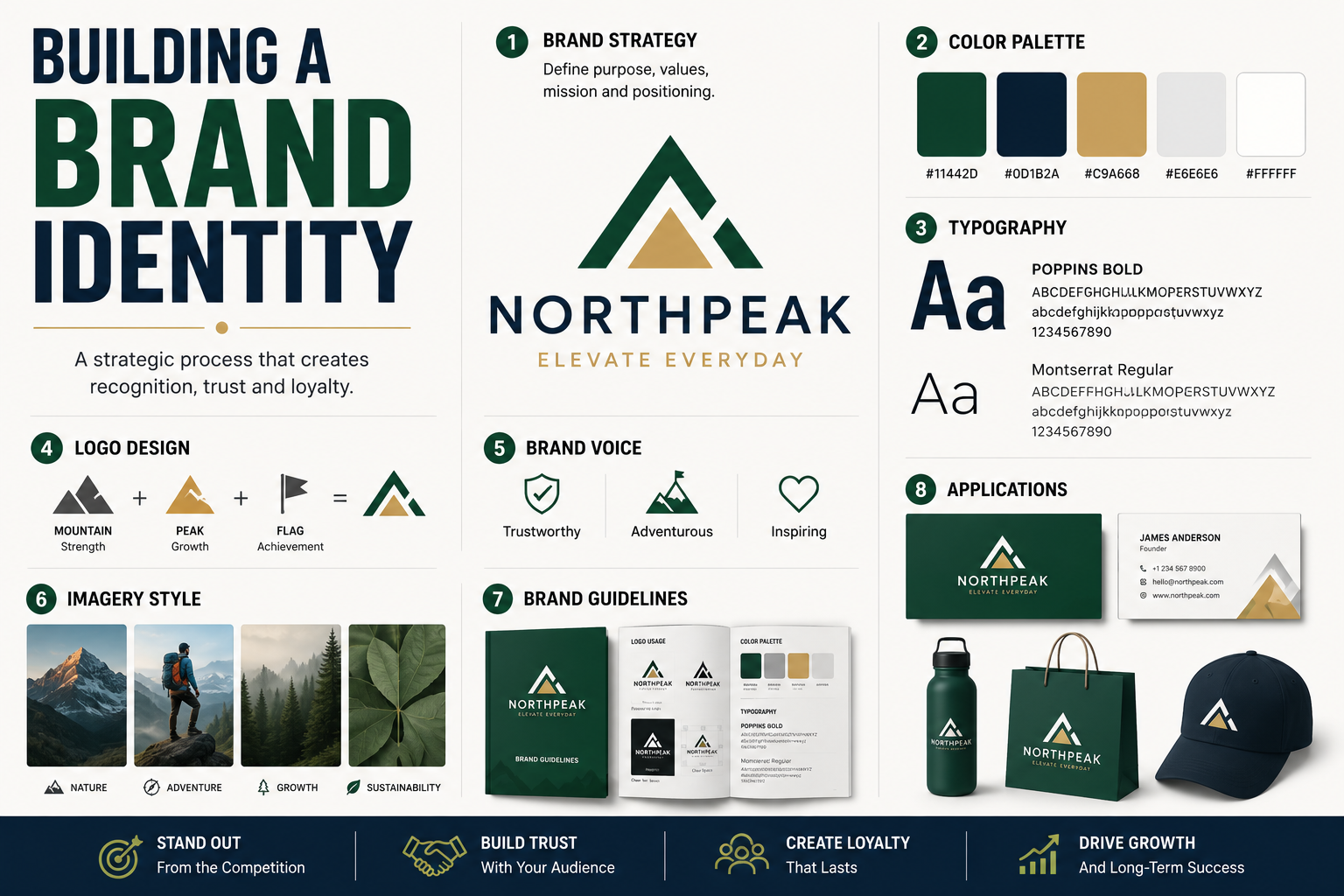
Building a Brand Identity: Logo, Colors, Voice, and Consistency
Let's cut through the marketing fluff for a moment. Building a brand identity isn't about picking a font you think looks "professional" or a color that matches your favorite sports team. It's the strategic process of defining who you are as a business, what you stand for, and how you want the world to perceive you—then systematically bringing that to life across every touchpoint. Studies show that consistent brand presentation across platforms increases revenue by up to 23% . When you're building a brand identity, you're not just designing a logo; you're creating a system that builds recognition, trust, and loyalty among your customers.
Of course, your brand is only as strong as the digital presence that supports it. If you're building a brand from scratch or refreshing an existing one, you'll likely need a website that actually converts and a digital marketing strategy to match.
What Is Brand Identity, Really?
Before you start designing, it's worth understanding what you're actually building. Brand identity is the collection of all elements that a company creates to portray the right image to its consumer . It's the visual and verbal expression of your brand—the things people can see, hear, and feel when they interact with you.
Brand Identity vs. Visual Identity vs. Brand Image
These terms get thrown around like confetti at a parade, but they're not the same thing. Your brand identity is the strategic core—your mission, values, personality, and positioning. Your visual identity is the physical manifestation of that strategy: the logo, colors, typography, imagery, and design elements that make you recognizable . And your brand image? That's how the public actually perceives you—which may or may not align with what you intended .
Think of it this way: building a brand identity is like writing a character for a novel. You define their personality, values, and backstory. The visual identity is how they dress, and the brand image is how readers actually feel about them—which, if you've done your job right, should be exactly what you intended. Unlike a novelist, however, you don't get to control the narrative once it's in the wild, which is why consistency is your best friend.
Step 1: Define Your Brand's Foundation
Before you open Adobe Illustrator or start brainstorming color palettes, you need to get the fundamentals right. Building a brand identity without a solid foundation is like building a house on sand—it might look good for a minute, but it won't last.
Your Purpose and Mission
Your brand's purpose is the "why" behind your existence. It's not "we sell widgets" but rather "we make widgets that help people do X more efficiently." Your mission statement articulates this in a way that guides your decisions and communicates your value to customers .
Ask yourself: Why does your business exist beyond making money? What problem do you solve for your customers? What impact do you want to have on your industry or community? The answers to these questions form the bedrock of your brand identity.
For a B2B agency like Devtaastic, our purpose might be helping US businesses build digital presences that actually perform—not just look pretty. For a B2C brand selling eco-friendly products, it might be making sustainable choices accessible to everyday consumers.
Your Core Values
Core values are the principles that guide your company's culture and decision-making. They should be authentic—not buzzwords you picked because they sounded good. When you're building a brand identity, your values should inform everything from how you treat employees to how you handle customer complaints .
Research shows that 81% of consumers need to trust a brand before making a purchase . Trust is built when your actions consistently align with your stated values. If you say you value transparency but hide your pricing, customers will notice—and they won't be coming back.
Your Unique Selling Proposition (USP)
What makes you different from every other business in your space? Your USP is the unique value you bring to the market that competitors can't easily replicate. It's the reason customers should choose you .
This requires honest competitive research. Look at what your direct competitors are doing, what they're saying, and how they're positioning themselves. Then figure out where the gaps are—and fill them .
Step 2: Know Your Audience

Building a brand identity that resonates requires understanding who you're talking to. Your brand might have a personality, but if it doesn't click with your target audience, you're effectively shouting into the void.
Creating Customer Personas
Customer personas are semi-fictional representations of your ideal customers based on market research and real data. They include demographics, behaviors, goals, pain points, and values .
For a B2B audience, your persona might be "Marketing Manager Mike," a 40-something professional who's overwhelmed by choice and needs an agency that can deliver results without hand-holding. For a B2C audience, it might be "Solopreneur Sarah," who's building her brand on a shoestring budget and needs guidance she can trust.
Understanding these personas isn't just a nice-to-have—it's essential for building a brand identity that speaks directly to the people you're trying to reach. When you know what they care about, you can align your messaging accordingly.
Competitive Research
Knowing your competitors is just as important as knowing your customers. What are they doing well? Where are they falling short? What messaging are they using, and who does it resonate with? This research helps you identify opportunities to differentiate your brand .
As one branding expert puts it, "Find your niche and define in very few words what makes your brand distinctive. If something doesn't fit those original three words—even though you might like it—scrap it" .
Step 3: Develop Your Visual Identity
This is where things get fun—and where many businesses go off the rails. Your visual identity includes your logo, color palette, typography, imagery, and overall design aesthetic . Here's how to do it right.
Logo Design
Your logo is the visual cornerstone of your brand identity. It should be scalable (works on a business card and a billboard), recognizable in both color and black and white, and reflective of your brand's personality .
But here's the thing: your logo isn't your brand. It's a symbol that represents your brand. Nike's swoosh means nothing without the emotional and experiential context Nike has built around it over decades .
Color Palette
Color psychology is real. Research from the University of Loyola found that color increases brand recognition by up to 80% . Choose colors that reflect your brand personality, appeal to your target audience, and stand out from competitors .
A good color palette typically includes:
- Primary color: The main color for your brand
- Secondary colors: Supporting colors for backgrounds and accents
- Accent colors: Contrasting colors for CTAs and highlights
Document your color codes in HEX, RGB, and CMYK so they can be applied consistently across digital and print materials.
Typography
Your font choices impact readability and brand perception. According to a study by Adobe, 75% of consumers judge a brand's credibility based on its website design—and typography plays a significant role .
Generally, you'll want two signature typefaces: one for headings and one for body text . Your body font should be highly legible across devices, while your heading font can be more expressive.
Imagery
This includes photography, illustration, iconography, and any other visual assets you use. Your imagery should have a consistent style and feel—whether that's corporate and polished, warm and candid, or abstract and artistic. And it should always reflect the people you're trying to reach .
A Quick Pricing Reality Check
If you're wondering what professional branding costs, here's a rough breakdown based on US agency data:
| Service | Budget Range | Average Hourly Rate (USA) |
|---|---|---|
| Logo Design | $2,000 - $10,000 | $50 - $150 |
| Visual Identity | $5,000 - $25,000 | $50 - $200 |
| Brand Guidelines | $5,000 - $25,000 | $120 - $200 |
| Brand Strategy | $12,000 - $60,000 | $130 - $150 |
| Full Brand/Rebrand Campaign | $50,000 - $250,000 | $100 - $200 |
These are average ranges from DesignRush's 2026 data . Keep in mind that costs vary significantly based on agency size, location, and scope. A full rebrand typically takes 3-6 months, while a quick refresh might run 8-12 weeks .
Step 4: Define Your Brand Voice
Your brand voice is how you sound across all communications. It's not what you say, but how you say it. Is your brand authoritative and professional? Warm and conversational? Playful and irreverent? .
Developing your brand voice typically involves defining 3-5 personality traits that describe your brand's communication style . To keep things from getting too abstract, a good exercise is to imagine your brand as a person. What are they like? What words would they use? What words would they never use?
As noted by one expert, brands often fall into the trap of chasing trends like the "sassy best friend" voice that started with Wendy's in 2017. Some brands nailed it; many earned the title of "corporate cringe" . The lesson? Your voice should be authentic to who you are, not a copy of what's trendy.
Remember, your tone might shift slightly depending on the platform—a LinkedIn post might be more formal than a Twitter exchange—but your core voice should remain consistent .
And if you're wondering how your brand voice translates to your website, our UI/UX design services can help ensure your visual and verbal identities are perfectly aligned.
Step 5: Create Brand Guidelines
Here's the thing about building a brand identity: if you don't document it, it doesn't exist. Well, not consistently, anyway. Your brand guidelines (also called a brand style guide or corporate identity manual) are the single source of truth for how your brand should be represented .
But here's the kicker: 85% of companies have brand guidelines, but less than a third actually follow them consistently . A document sitting in a shared drive is just a document. A brand guideline that's actually used is a strategic asset.
Your guidelines should include:
- Brand positioning statement: What you stand for and who you serve
- Mission and values: Your purpose and principles
- Logo usage: How and where to use it, what not to do
- Color palette: Color codes (HEX, RGB, CMYK) and usage rules
- Typography: Approved fonts for different contexts
- Tone of voice: Personality traits, dos and don'ts, examples
- Imagery guidelines: Photography style, iconography, illustration
- Templates: Business cards, presentations, email signatures, social posts
Brand consistency builds familiarity, and trust is the payoff. In a noisy, AI-cluttered market, brand recognition is essentially business survival .
Common Branding Mistakes to Avoid
Even well-intentioned businesses make these mistakes. Building a brand identity is complex, and it's easy to go wrong.
Copying competitors. Mimicking what's working for other brands makes you look unoriginal and untrustworthy . It's like showing up to a party wearing the same outfit as someone else—only you paid a lot of money for it, and it's not your style anyway.
Inconsistency across platforms. Using different logos, colors, or tones on different channels confuses customers and weakens your brand . Every touchpoint should feel like it comes from the same organization.
Focusing only on visual elements. A great logo means nothing if your customer service is terrible or your brand voice is all over the place . Your brand is the total experience.
Overcomplicating your brand. Too many colors, fonts, or design elements make your brand feel chaotic . Simplicity is almost always more memorable and effective.
Failing to evolve. Sticking with the same branding as your business grows can make you seem outdated or irrelevant . Your brand should be flexible enough to evolve without losing its core identity.
If you're concerned that your current website is doing more harm than good to your brand, check out our guide on 10 signs your website needs a redesign to see if it's time for a refresh.
Frequently Asked Questions
What is the difference between a brand and a logo?
A logo is a visual symbol that represents your brand. Your brand is the entire perception people have of your business—including your values, mission, voice, customer experience, and reputation. Your logo is part of your brand, but it's not your brand .
How do I choose the right colors for my brand identity?
Start by considering your brand personality, target audience, and industry context. Different colors evoke different emotions—blue often conveys trust and professionalism, while yellow suggests energy and optimism. Choose colors that reflect your values and resonate with your audience, then document exact color codes for consistency .
How much does it cost to build a brand identity?
Costs vary significantly based on scope and agency. A logo might run $2,000-$10,000, while a full brand identity including strategy, visual identity, and guidelines can range from $10,000-$60,000. Full rebrand campaigns can exceed $50,000 . US branding agencies typically charge $140-$200 per hour.
Why is brand consistency so important?
Consistency builds recognition, trust, and loyalty. Research shows that consistent brand presentation increases revenue by up to 23%, and brands with high consistency often see revenue growth of 10% or more . When customers know what to expect from your brand, they're more likely to trust and remain loyal to it.
What's the difference between a brand refresh and a rebrand?
A brand refresh involves updating visual elements and modernizing the brand without changing core positioning. A full rebrand rethinks everything—positioning, messaging, visual identity, and often the name—usually in response to major business changes .
Your Next Step: Build a Brand That Actually Works
Building a brand identity isn't a one-time project; it's an ongoing process that requires attention, consistency, and sometimes a willingness to evolve. Whether you're a startup in Austin or a legacy business in Chicago, your brand is the most valuable asset you own—and it's worth investing in.
At Devtaastic, we help US businesses build brands that don't just look good, but perform. From strategy and design to web development and SEO services, we understand that a brand is only as strong as its execution. We've seen the damage that inconsistent branding can do, and we've seen the revenue growth that comes from getting it right.
Ready to stop guessing and start building a brand identity that connects with your audience and drives real results? Let's talk.
Stop Building Your Brand on Autopilot
Get a free, no-obligation consultation on brand strategy and identity design tailored to your US business.
Get a Free QuoteNo pressure. Just a conversation about building a brand that works as hard as you do.