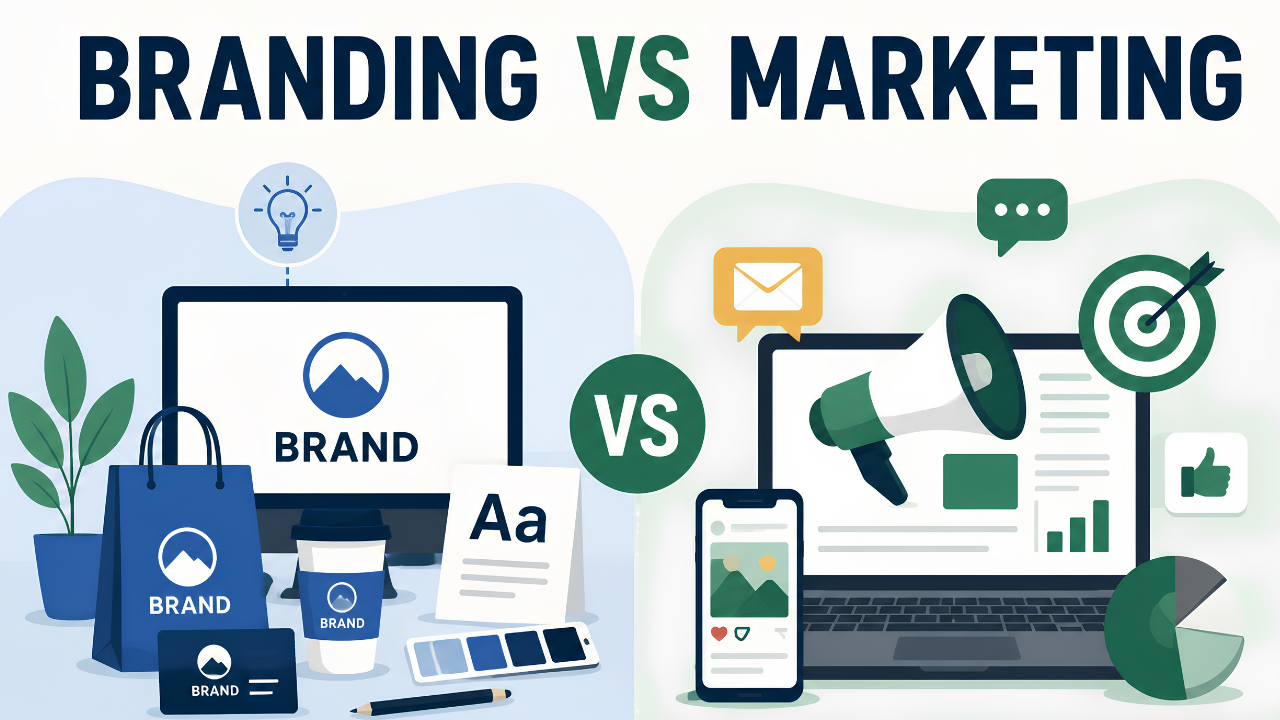
The confusion between branding and marketing is one of the most reliably expensive mistakes a business can make — not because either concept is complicated, but because conflating them leads to allocating budget to the wrong problems at the wrong time. Marketing spend without a clear brand foundation is roughly equivalent to running a very efficient advertising campaign for a business the customer immediately forgets; the traffic shows up, looks around, finds nothing particularly memorable, and leaves. This guide draws the distinction clearly, explains how the two work together, and helps you figure out which one your business actually needs to prioritize right now — before another quarter of marketing spend produces results that are politely described as "mixed."
Defining the Terms: What Branding Actually Is

Branding is the sum of what your business is perceived to be. Not what you say it is — what customers, prospects, and the general public actually believe it to be based on every interaction they've had with you. Your brand is the answer to the question a potential customer asks after encountering your business for the first time: So, what is this place, and is it for me?
The components that make up a brand identity fall into two categories: what you can see, and what you can feel.
Visual Brand Identity
The visible elements of a brand are the ones most people refer to when they say "branding" — usually meaning "logo," which is a bit like describing a house as "the door." The visual brand identity includes:
- Logo — the mark that represents your business across all touchpoints
- Color palette — typically 2–4 primary colors used consistently across all communications
- Typography system — specific font choices for headings, body copy, and UI elements
- Visual style — the photographic direction, illustration style, iconography, and overall aesthetic
- Design templates — how these elements come together in presentations, social posts, proposals, and email
Brand Strategy and Positioning
The strategic layer of branding is less visible but more important. It governs every decision the visual layer expresses:
- Brand purpose — why the business exists beyond making money
- Target audience — who the brand is specifically for (and implicitly, who it isn't for)
- Positioning statement — how you're different from competitors in a way that matters to your audience
- Brand values — the principles that guide decisions, from hiring to communication to pricing
- Tone of voice — how the brand communicates in writing and speech
- Brand promise — what customers can reliably expect every time they interact with you
This strategic layer is what separates a brand from a logo with an associated color scheme. Many small businesses have the second and think they have the first, which is a comfortable illusion until a competitor with actual brand positioning enters the market and makes the distinction rather obvious.
Defining the Terms: What Marketing Actually Is

If branding is who you are, marketing is how you tell people about it. Marketing encompasses all the activities used to promote your business, attract customers, and generate revenue. It operates through channels — SEO, email, paid advertising, social media, content, events — and it's campaign-driven, which means it has defined start dates, end dates, audiences, messages, and measurable outcomes.
Marketing is where most business owners spend the majority of their attention and budget, partly because it produces visible, measurable activity — impressions, clicks, leads, conversions — and partly because it feels like doing something, which is easier to justify than the less immediately tangible work of building a brand foundation. The instinct is understandable. Spending six weeks on a brand positioning workshop while your competitor is running Google Ads requires a certain tolerance for delayed gratification that not everyone possesses.
The Core Marketing Disciplines
Modern marketing for a US small business typically spans some combination of the following:
- Content marketing — blog posts, guides, video, and educational content that builds organic visibility and audience trust over time
- Search engine optimization — the technical and content work that determines where your website appears in Google search results
- Paid advertising — Google Ads, Meta Ads, LinkedIn Ads, and other paid channels that generate immediate, measurable traffic
- Email marketing — direct communication to a permission-based subscriber list, with consistent high ROI for businesses that do it well
- Social media marketing — organic and paid presence on platforms where your audience spends time
- Conversion rate optimization — improving the percentage of website visitors who take a desired action, which is the marketing discipline most frequently skipped and most reliably worth funding
All of these disciplines benefit enormously from strong branding. A Google ad for a business with clear, compelling positioning outperforms the same ad spend for a business with generic messaging. An email campaign with a consistent, recognizable brand voice generates higher open rates than one that reads like it was written by a committee that hadn't met before. Good branding is marketing leverage — it makes every marketing activity work harder, which is the most efficient use of a marketing budget that most businesses never pursue.
Branding vs Marketing: A Direct Comparison
The relationship between branding and marketing is often described as "branding is the why, marketing is the how" — which is accurate in the same way that "a car is for going places" is accurate: technically correct, not particularly useful. Here's a more operational breakdown:
| Dimension | Branding | Marketing |
|---|---|---|
| Primary purpose | Define and express who you are | Communicate and promote what you offer |
| Time horizon | Long-term, strategic, compounding | Campaign-driven, tactical, measurable |
| Core output | Identity system, guidelines, positioning | Campaigns, content, leads, conversions |
| Success metric | Brand recognition, loyalty, perception | Traffic, leads, cost per acquisition, ROAS |
| Change frequency | Rarely — evolution, not revolution | Frequently — tested, optimized, replaced |
| Owner in a small business | Founder / brand strategist | Marketing manager / agency / in-house team |
| When it pays off | Years — trust and recognition compound slowly | Weeks to months — results are trackable |
| What happens without it | Generic, forgettable, easily replaced | No awareness, no traffic, no leads |
The table above contains a trap worth noting: both rows in the "what happens without it" column describe real and serious problems. A business with great branding and no marketing has a beautiful identity that nobody encounters. A business with heavy marketing spend and no brand has lots of traffic arriving at a destination that fails to make a lasting impression. Both conditions are expensive in different ways, and the second one is more common — businesses that market aggressively without a brand foundation often discover their cost-per-lead rising over time as the absence of differentiation forces them to outspend competitors rather than out-position them.
Why Startups and Small Businesses Get This Wrong
The branding-vs-marketing confusion is not a sign of inexperience. It's a structural problem created by the urgency of early-stage business. When you need revenue in thirty days, the case for spending three weeks on brand positioning is a difficult one to make to yourself, your co-founder, or your bank account. Marketing produces something visible. Branding produces something foundational, and foundations are easy to undervalue until the structure above them develops cracks.
For startups specifically, the sequencing problem is real. You need to validate your idea before investing heavily in brand identity — as the team at Purple Startups documents extensively, the validation mistakes that kill companies before launch are usually strategic, not executional. But validation doesn't mean ignoring brand entirely. Even a pre-launch business benefits from a clear positioning hypothesis: who is this for, what problem does it solve better than alternatives, and why should someone trust us to solve it?
The answer to sequencing for most early-stage businesses is a minimum viable brand: enough positioning, visual identity, and tone of voice to market consistently, without the full investment of a comprehensive brand identity system. As the business proves itself and revenue grows, the brand investment scales accordingly. The growth strategies that work at Series A look very different from the ones that work at pre-revenue — brand investment follows the same curve.
How Branding and Marketing Work Together
The most effective businesses treat branding and marketing not as competing priorities but as different layers of the same system. Brand strategy defines the message; marketing strategy defines how, where, and when that message reaches the right people. Separating them conceptually is useful for diagnosis. Running them separately in practice is how you end up with marketing campaigns that contradict your brand positioning, which is more common than the people responsible for it would be comfortable admitting.
Brand Consistency Across Marketing Channels
Every marketing channel your business uses should express the same brand identity — the same visual language, the same tone of voice, the same core positioning. A customer who encounters your Google ad, then your website, then your Instagram profile, then your email newsletter should feel a consistent throughline. The specific format adapts to the channel; the brand does not. Inconsistency across channels creates cognitive friction — the customer subconsciously registers that something doesn't add up, and trust decays accordingly, which is an outcome that's difficult to track in a spreadsheet and very easy to produce by accident.
Your website is where brand and marketing converge most visibly. It's the destination for almost every marketing activity — paid search, organic SEO, social media, email campaigns, referrals — and it has to carry both the brand identity and the conversion architecture simultaneously. A website that expresses the brand beautifully but fails to convert is a branding success and a marketing failure. A website that converts efficiently but looks like it was built by someone who treats brand guidelines as optional is a marketing success with a ceiling on it. A well-built website resolves this tension by design — literally.
Brand Building Through Content Marketing
Content marketing sits at an interesting intersection of branding and marketing. A well-executed content strategy serves both simultaneously: it builds brand authority and recognition over time (branding function) while generating organic traffic and leads (marketing function). The blog post you're reading right now is an example of this — it exists to rank for search terms, attract readers who match our target audience, and demonstrate the kind of thinking that characterizes the Devtaastic brand. One piece of content; two jobs.
This dual-purpose nature of content is why it's worth investing in carefully. Content that expresses a clear brand voice and covers topics your audience genuinely cares about compounds in both directions — building SEO authority and brand recognition simultaneously, without requiring a separate budget for each. The businesses that understand this tend to produce fewer, better pieces of content rather than more, mediocre ones, which is an observation that applies equally to branding and to several other aspects of life.
What to Fix First: A Decision Framework
The practical question most business owners are really asking when they encounter the branding-vs-marketing discussion is: where should I spend my limited time and budget right now? Here's a diagnostic:
Fix Your Branding First If:
- You can't articulate what makes your business different from competitors in one sentence
- Your visual identity is inconsistent across your website, social media, and printed materials
- Marketing campaigns produce traffic but low conversion rates — visitors arrive and leave without engaging
- You've had to compete primarily on price because customers don't perceive differentiated value
- Your team produces communications that look and sound different from each other without a style guide to unify them
Fix Your Marketing First If:
- You have clear positioning and a consistent brand identity but low visibility — nobody knows you exist
- Your website converts well for the visitors it gets, but traffic is insufficient
- You have a referral-dependent business and need to build an inbound channel
- You have a strong brand in one market and are expanding to new audiences or geographies
Fix Both Simultaneously If:
- You're launching a new business or rebranding an existing one
- You're at the stage where revenue growth requires professionalization of both the identity and the acquisition channels
- A competitor has recently entered your market with better brand positioning and better marketing execution — a situation that calls for urgency on both fronts, if perhaps slightly more urgency on the branding side before you invest further in a marketing system that's outgunned
For businesses in growth mode, the combination of a clear brand foundation and a well-executed digital marketing strategy produces results that neither produces alone. The entrepreneurs who understand this distinction early — and there's a good argument that battle-tested startup leadership requires both brand clarity and marketing discipline from day one — tend to scale faster and with less wasted spend than those who discover the relationship between the two concepts after a few expensive campaigns.
The Role of Your Website in Both
If branding is your identity and marketing is your communication, your website is the physical address where both live. It is simultaneously the most visible expression of your brand and the most important conversion asset in your marketing stack. Getting it right requires understanding both disciplines — the brand has to be expressed credibly and consistently, and the marketing architecture has to move visitors toward a decision.
This is why businesses that treat website design as purely a visual exercise often find their marketing underperforms expectations. And why businesses that treat it as purely a technical or conversion exercise find their brand positioning undermined by a site that looks generic. High-converting landing pages that also express brand identity clearly are not the product of compromising between two competing priorities — they're the product of understanding that the two priorities are not actually in competition. You can have a site that's beautiful, on-brand, fast, and built to convert. It just requires intentional execution rather than the default outcome of treating design and marketing as separate workstreams handled by people who don't talk to each other.
The SEO work that drives traffic to that site also benefits from brand clarity — branded searches, consistent anchor text, and coherent topical authority are all brand-adjacent signals that affect organic rankings. Everything connects, which is either a reassuring sign of systemic integrity or a mildly alarming reminder that a weakness anywhere in the system affects performance everywhere. Probably both.
Frequently Asked Questions
What is the main difference between branding and marketing?
Branding defines who your business is — your identity, values, visual language, tone of voice, and the impression you leave on anyone who encounters you. Marketing is how you communicate that identity to the world through specific channels and campaigns. Branding is strategic and long-term; marketing is tactical and campaign-driven. Branding sets the foundation; marketing builds on top of it. Running marketing without established branding is like building a house on a foundation that hasn't been inspected — it may hold for a while, but the cracks are coming.
Should I focus on branding or marketing first?
Branding first, always. Marketing amplifies whatever your brand communicates — if that communication is unclear or indistinguishable from competitors, marketing spend accelerates the problem rather than solving it. You don't need a complete brand identity system before you do any marketing, but you need a clear answer to "what do we stand for and who is it for" before spending money on campaigns.
Can a small business do its own branding?
Yes, with caveats. A small business owner who understands their audience, competitors, and differentiation can develop a functional brand strategy without external help. The visual execution — logo, color system, typography — typically benefits from professional design work, because the gap between "looks okay to me" and "looks credible to a prospective customer" is significant and difficult to see from the inside. Brand strategy you can own; brand execution you may want help with.
How does branding affect SEO and digital marketing performance?
Strong branding improves digital marketing performance in measurable ways. Branded searches are a positive ranking signal. Higher brand recognition improves email open rates, ad click-through rates, and organic CTR. A consistent brand presence across your website, social media, and content also reduces bounce rate, because visitors whose expectations are correctly set by your brand are more likely to stay and engage.
What does brand identity include?
Brand identity includes your logo, color palette, typography system, visual style, tone of voice, tagline, and brand messaging framework. It also includes your brand's positioning relative to competitors and the emotional associations you want customers to have. All of these should be documented in a brand guidelines document so that anyone producing content or communications for your business is working from the same foundation — rather than the same general direction, which is a meaningfully different thing.
Build the Brand. Fund the Marketing. Get Both Right.
Devtaastic works with US businesses at every stage of the brand-and-marketing equation — from companies that need a website that expresses a strong brand identity to businesses that need an SEO and content strategy that builds recognition over time. We design and build the web presence, and we connect the marketing infrastructure that makes it produce leads.
If you're not sure whether your current challenge is a branding problem, a marketing problem, or the particularly entertaining combination of both, browse our portfolio, read through our marketing services, or skip straight to the part where you get a free quote. No pitch deck, no jargon, no forty-five minute discovery call designed primarily to qualify you as a prospect. Just a straight conversation about what you're building and what it takes to make it work.