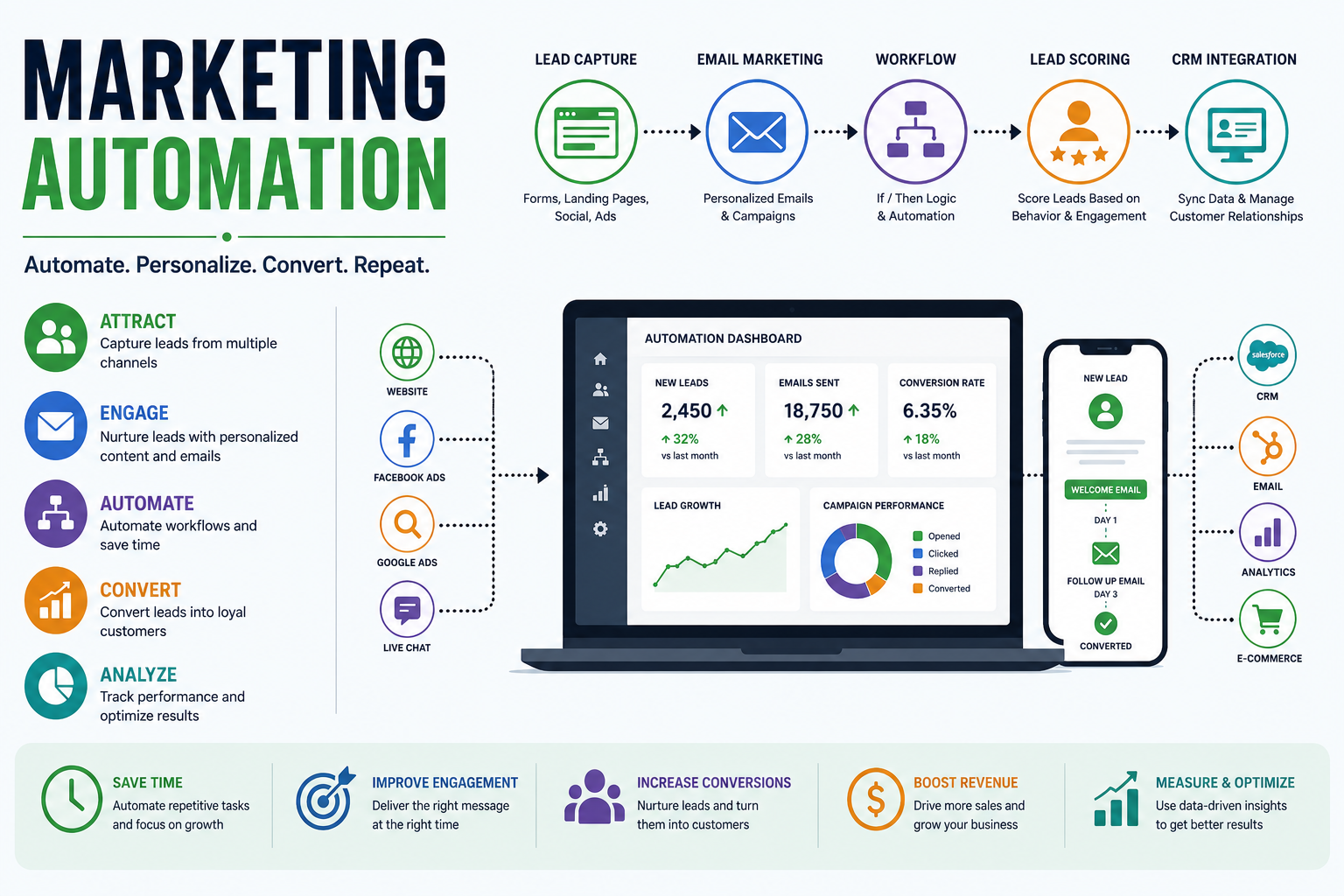
Marketing Automation for Small Businesses: Where to Start
Let's be honest: as a small business owner, you're wearing at least six hats before lunch, and marketing is usually the one that gets shoved to the bottom of the pile. Marketing automation for small businesses isn't about replacing your humanity with robots—it's about giving the robots the repetitive tasks so you can focus on the stuff that actually requires a human brain. Studies show that marketers using automation are 46% more likely to report effective strategies, and businesses that use it outperform their competitors by 63% . That's not magic; that's just not wasting time manually copying email addresses from one spreadsheet to another.
If you're already spending hours each week sending emails, posting on social media, or chasing leads, you're prime for automation. The question isn't whether you can afford it—it's whether you can afford not to.

What Is Marketing Automation, Exactly?
In plain English, marketing automation is using software to handle repetitive marketing tasks automatically. Instead of manually sending each email, posting every social media update, or entering lead data by hand, you set up workflows that run themselves based on customer behavior . It's the digital equivalent of a crockpot—you do the prep work, and it handles the cooking while you sleep.
Marketing automation can handle everything from email sequences and lead scoring to social media posting and ad campaign management . The goal isn't to remove the human touch—it's to make sure that when you do interact with customers, it's meaningful, not just mechanical.
Marketing Automation vs. CRM: Why You Need Both
Here's where people get confused. A CRM (Customer Relationship Management) system is your source of truth for customer data—it stores interactions, purchase history, and contact details. Marketing automation is the muscle that acts on that data .
Think of it this way: your CRM knows that Sarah bought a product three months ago and hasn't opened an email in six weeks. Marketing automation takes that information and sends Sarah a re-engagement offer automatically . When you use both together, you get the best of both worlds—accurate data and timely action.
Using them separately is like having a smartphone with no apps—technically functional, but you're missing the whole point.
Benefits of Marketing Automation for Small Businesses
If you're still on the fence, consider what automation actually delivers for lean teams with tight budgets.
Time Savings That Actually Matter
The average small business owner has about an hour a day to spend on marketing . That's not enough time to do everything manually. Automation takes over the grunt work—email sends, social posts, lead tracking—so you can focus on strategy and creative work . One study found that businesses using automation see a 14.5% increase in sales productivity and a 12.2% reduction in marketing overhead costs .
Better Customer Engagement
Automation isn't just about efficiency; it's about effectiveness. Personalized triggered emails have 25% higher open rates and 51% higher click rates than generic blasts . When you send the right message at the right time based on actual behavior, customers feel understood—not spammed.
Actionable Data and Insights
Good automation platforms collect data and show you what's working and what isn't. Organizations that leverage behavioral insights outperform peers by 85% in sales growth . Without automation, you're guessing. With it, you're making informed decisions.
Where to Start: 6 Tasks You Should Automate Today

You don't need to automate everything at once. Start with these high-impact tasks that deliver quick wins.
1. Welcome and Onboarding Sequences
When someone signs up for your email list or buys a product, they expect an immediate confirmation. Automation handles this effortlessly . Set up a welcome series that introduces your brand and offers value over several days. A B2B SaaS company might send a five-day onboarding flow with one helpful tip per day, while an ecommerce store might offer a first-purchase discount code.
2. Abandoned Cart Recovery
For ecommerce businesses, abandoned cart emails are one of the highest-ROI automations you can implement . A customer adds items to their cart, gets distracted by a cat video, and leaves. Automation sends a gentle reminder—sometimes with a discount code—and recovers sales you'd otherwise lose. With Shopify's built-in features, you can start doing this with zero extra cost .
3. Post-Purchase Follow-Ups
Automating review requests and post-purchase follow-ups keeps customers engaged after the sale. Set a trigger to ask for a review three days after delivery or service completion . The experience is fresh, and you'll get more authentic feedback than if you ask a month later.
4. Lead Scoring and Sales Handoffs
Not all leads are created equal. Automation can score leads based on their behavior—website visits, email opens, content downloads—and route hot leads directly to sales . This ensures your sales team focuses on the people most likely to buy, not the ones who just clicked "subscribe" by accident.
5. Re-Engagement Campaigns
Some leads go cold. It happens. Automation can identify contacts who haven't opened an email in 90 days and send a re-engagement campaign offering something of value . This can revive relationships that might otherwise be lost forever.
6. Confirmation and Transactional Emails
Every time a customer books an appointment, registers for an event, or makes a purchase, they expect a confirmation. Automation handles this instantly, and you can add value by including related offers or helpful information .
The Three Things You Need to Get Started
Marketing automation runs on three core components: data, rules, and content . Get these right, and everything else falls into place.
1. Customer Data
You need basic information about your leads—name, email, what they've done on your site, what they've bought. Capture this through forms, integrations, or imports . The more you know about your audience, the better you can segment and personalize.
2. Rules and Triggers
Rules define what happens when. If a customer abandons their cart, send a reminder. If a lead downloads a white paper, add them to the nurture sequence . Start simple and build complexity as you go.
3. Relevant Content
Automation is useless without content to send. You need welcome emails, follow-up sequences, and offers that match your customers' needs . If you're creating content anyway for your blog or marketing campaigns, you can easily repurpose it for automated sequences.
Top Marketing Automation Tools for Small Businesses
There's no shortage of tools, but not all are created equal. Here's a breakdown of the most popular options for US-based SMBs.
| Tool | Best For | Starting Price |
|---|---|---|
| Brevo | All-in-one email + SMS + CRM | Free (300 emails/day) to $9/month |
| ActiveCampaign | Powerful automation + CRM | $15/month for 1,000 contacts |
| Mailchimp | Beginner-friendly email | Free for 500 contacts, $13/month paid |
| Klaviyo | Ecommerce email + SMS | Free for 250 contacts |
| Zapier | Connecting apps without code | Free basic, $20/month paid |
| HubSpot | All-in-one CRM + marketing | Free tier, paid from $800/month |
Best Practices for Marketing Automation Success
Automation isn't a "set it and forget it" solution—it requires thoughtful implementation and ongoing refinement.
Define Your Audience and Goals First
Before you automate anything, know who you're talking to and what you want to achieve. Use SMART goals (Specific, Measurable, Achievable, Relevant, Time-bound) to guide your efforts . Trying to automate without a clear strategy is like setting your cruise control to 80 and hoping for the best—eventually, you'll end up in a ditch.
Start Simple and Scale Up
Don't try to automate everything at once. Start with one or two workflows—like a welcome series or abandoned cart recovery—and expand as you see results . Complex automations are impressive, but they're also harder to troubleshoot.
Measure Performance and Iterate
Use analytics to track open rates, click-through rates, and conversions. Then test and refine. A/B testing can increase conversions by up to 400% . What works today might not work tomorrow, so keep testing.
Balance Automation with Human Touch
Automation handles the repetitive stuff, but it can't replace genuine human connection. Know when to automate and when to step in personally . A triggered email is great, but a handwritten note from the founder? That's gold.
Frequently Asked Questions
Is marketing automation expensive for small businesses?
No. Many platforms offer free tiers (Brevo, Mailchimp, Klaviyo) or affordable paid plans starting under $20 per month. For many ecommerce businesses using Shopify, automation features are built into the platform at no extra cost . You can start small and scale as your business grows.
What's the difference between email marketing and marketing automation?
Email marketing is sending a newsletter to everyone on your list. Marketing automation creates behavior-triggered journeys—welcome sequences, abandoned cart reminders, re-engagement campaigns—that send different messages based on what each customer does . Automation is personalized; email blasts are not.
Do I need a CRM to use marketing automation?
Not necessarily, but it helps. Many marketing automation platforms include built-in CRM features. Having both integrated ensures your data stays accurate and your messages are always based on the most up-to-date customer information .
What tasks can I automate first as a small business?
Start with welcome emails, abandoned cart recovery, post-purchase follow-ups, and lead scoring. These tasks are straightforward to set up and deliver quick ROI . Once you've mastered these, expand to re-engagement campaigns and more complex workflows.
What are the best marketing automation tools for US small businesses?
For email-focused businesses, Brevo and Mailchimp are popular starting points. For ecommerce, Klaviyo is the standout. For businesses that need to connect multiple apps, Zapier is incredibly useful. For a full suite including CRM and sales tools, HubSpot and ActiveCampaign are excellent options .
Your Next Step: Start Automating Today
Marketing automation for small businesses isn't a luxury—it's a necessity if you want to compete in 2026. The tools are affordable, the setup is straightforward, and the ROI is proven. But here's the thing: you don't have to figure it all out alone.
At Devtaastic, we help US-based businesses build and execute marketing strategies that actually work. Whether you need help with SEO, digital marketing strategy, or a full website redesign, we've got the expertise to make sure your marketing doesn't just run on autopilot—it drives real results.
Ready to stop wasting time on manual marketing and start seeing real growth? Let's talk.
Stop Marketing on Manual
Get a free, no-obligation consultation on marketing automation and strategy tailored to your US business.
Get a Free QuoteNo pressure. Just a conversation about helping your marketing run itself.