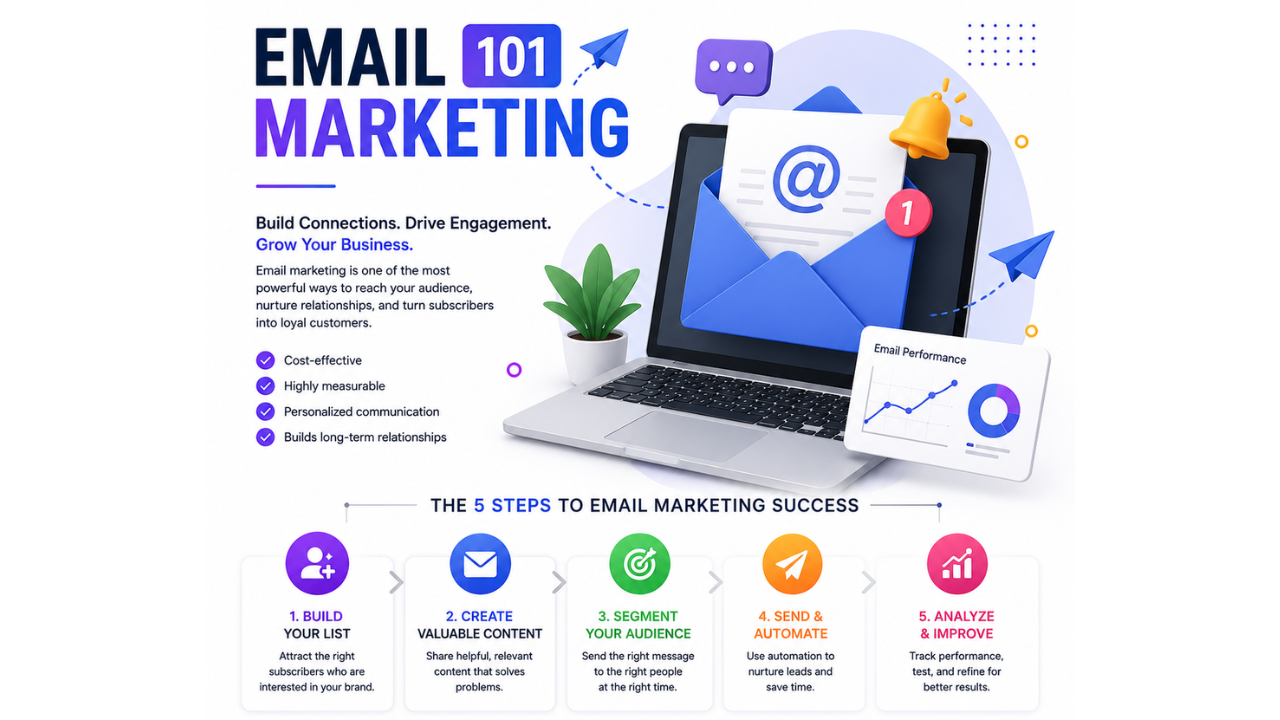
Of all the Email Marketing for small business channels available in 2026, email marketing remains the one with the highest return on investment, the lowest platform dependency, and the most consistent performance across industries. It is also, perhaps not coincidentally, the one most businesses are actively doing wrong. They've built a list — technically — in the same way that a pile of unsorted paperwork is technically a filing system. They send newsletters sporadically, watch the open rates with the quiet despair of someone checking their bank balance, and conclude that email marketing doesn't work. What doesn't work, in almost every case, is the list-building strategy that preceded the sending. This guide covers how to build an email list that converts: the right lead magnets, the right opt-in placement, the right nurture sequence, and the metrics that tell you whether any of it is actually doing what you think it's doing.
Why Your Email List Is Worth More Than Your Social Following

The distinction matters enough to address directly before anything else: your email list is an asset you own. Your Instagram following, your Facebook page audience, your LinkedIn connections — those live on someone else's infrastructure, subject to algorithm changes, platform policy shifts, and the occasional inexplicable reach collapse that affects your entire audience simultaneously and is explained in the platform's blog post with the phrase "improving user experience." Your email list goes with you regardless of what any platform decides to do with its engagement algorithm next quarter.
The ROI data consistently supports this. Email marketing returns an average of $36–$42 for every $1 spent, according to US-focused studies from Litmus and Campaign Monitor — a figure that makes most paid social campaigns look like a polite suggestion. The channel works because it operates on permission: every person on your list has, at some point, explicitly said they want to hear from you. That's not something you can say about the person who liked your Instagram post and then forgot you existed.
The Permission Economy and What It Means for List Building
Permission-based email marketing isn't just an ethical best practice — it's a strategic one. A list of 500 subscribers who genuinely opted in to hear from you will outperform a list of 5,000 scraped or purchased contacts every time, in open rates, click rates, and conversion rates. The size of your list is the vanity metric. The quality of the attention your list gives you is the business metric.
This means list-building strategy is really attention-earning strategy. You're not collecting email addresses — you're recruiting an audience that has decided your perspective or your resources are worth a slot in the most contested real estate in their professional lives: their inbox. Treating that with anything less than respect is the fastest path to the spam folder, which, unlike purgatory, has no appeal process.
Building Your Email List: The Four Methods That Actually Work

There are dozens of list-building tactics in circulation. Most of them work in the same way that a stopped clock works: occasionally, and not reliably enough to build a strategy around. These four work consistently across B2B and B2C contexts for US small businesses.
1. Lead Magnets That Earn the Opt-In
A lead magnet is the exchange offer — you give something valuable, the reader gives you their email address. The critical word is "valuable," which has been so thoroughly diluted by a decade of PDF checklists that the bar for what constitutes genuine value has moved significantly upward. In 2026, a lead magnet that converts needs to be specific, immediately useful, and genuinely not available anywhere else for free.
Lead magnets that consistently convert for small businesses:
- Industry-specific templates — a proposal template, a pricing calculator, a content calendar, a project brief document. Something your audience would otherwise have to build themselves.
- Diagnostic tools or audits — a self-assessment checklist, a scoring rubric, a "how does your [thing] compare" framework. These work because they give the reader information about themselves, which is the most engaging category of information there is.
- Condensed expert guides — not a 40-page e-book that takes three hours to read and arrives in a PDF that nobody opens. A tight, specific, opinionated guide that solves one problem well. Five pages beats forty if the five pages are useful.
- Free first-step offers — a free website audit, a free consultation, a free mockup. Higher commitment to deliver, but significantly higher conversion rate and lead quality. Someone who opts in for a free deliverable is much further along the buying journey than someone who opted in for a PDF.
- Email courses — a sequence of 5–7 emails delivered over a week that teaches something specific. These double as a nurture sequence, keep your list engaged from day one, and demonstrate expertise better than a static document.
2. Opt-In Placement That Doesn't Rely on Hope
Most small business websites have an email opt-in somewhere at the bottom of the page, beneath the footer, in a font size usually associated with legal disclosures. This is optimistic placement, in the same way that placing a speed bump at the edge of a cliff is optimistic road safety engineering. The opt-in needs to be where the attention already is.
High-converting opt-in placements:
- Within blog post content — inline, after a section that delivers genuine value, not buried at the end after the reader has already decided to leave
- Exit-intent popups — triggered when a user's cursor moves toward the browser tab, not the moment they arrive on the page. Arrival popups are how websites communicate "we have no respect for your reading experience"
- Dedicated landing pages — a standalone page built specifically to convert opt-ins, with no navigation, no distractions, one offer, one CTA. These are the opt-in placements worth sending paid traffic to
- After delivering value — at the end of a free tool, a quiz result, a calculator output. The moment after someone has received something useful from you is the highest-intent moment for an opt-in ask
3. Content Upgrades
A content upgrade is a lead magnet that is specific to a single piece of content — a bonus resource that extends or supplements what the reader just consumed. If someone reads your blog post about social media marketing, a content upgrade might be the social media content calendar template referenced in the post. The conversion rate on content upgrades is typically 3–5x higher than a generic site-wide opt-in, because the reader is already invested in the topic and the offer is directly relevant to what they're reading.
Content upgrades require more work — each one has to be created and connected to its corresponding content — but for high-traffic blog posts, the return on that work is considerable. If you have one post that drives 80% of your organic traffic and it has no content upgrade, that's the first place to invest.
4. Social Proof and Subscriber Framing
How you describe your list matters. "Subscribe to our newsletter" is a request that sounds like it benefits you. "Join 4,200 business owners who get weekly tips on growing their web presence" is a statement that makes the reader feel they're joining something. One of those framings converts at a meaningfully higher rate, and it's not the one that puts the brand at the center of the ask.
Email Marketing Platform Comparison for Small Business
The platform you build on affects deliverability, automation capabilities, and — eventually — your costs. Here's a clear comparison of the most widely used options for US small businesses:
| Platform | Free Tier | Starting Paid Price | Best For | Automation | E-commerce Integration |
|---|---|---|---|---|---|
| Mailchimp | Up to 500 contacts | ~$13/mo | Beginners, general small business | Basic | Good |
| ConvertKit (Kit) | Up to 10,000 subscribers | ~$25/mo | Creators, solopreneurs, bloggers | Strong | Moderate |
| ActiveCampaign | None | ~$15/mo | B2B, CRM integration, advanced automation | Excellent | Strong |
| Klaviyo | Up to 250 contacts | ~$20/mo | E-commerce, Shopify stores | Excellent | Best-in-class |
| Brevo (Sendinblue) | 300 emails/day | ~$9/mo | Budget-conscious, transactional email | Good | Moderate |
| Beehiiv | Up to 2,500 subscribers | ~$42/mo | Newsletter-first businesses, media brands | Moderate | Limited |
For most small businesses starting from zero: ConvertKit's free tier is the most generous entry point if you're in a content-driven or creator business. Klaviyo is the clear choice if you're running a Shopify store. ActiveCampaign is worth the cost if you need CRM-level automation and your sales cycle involves more than a single touch. Mailchimp remains fine for simple use cases and less fine the moment your needs grow more sophisticated than "send a monthly newsletter and occasionally wonder why deliverability is declining."
The Welcome Sequence: Where Lists Become Relationships

The moment someone subscribes is the highest-attention moment you will ever have with them. Open rates on welcome emails average 50–60% in the US — roughly three to four times the open rate of a typical campaign email. This is the equivalent of a first date where they've already decided they like you; what you do with it determines whether there's a second one, or whether you end up classified under their email filter labeled "things I opted into and immediately regretted."
What a High-Converting Welcome Sequence Looks Like
A welcome sequence is a series of automated emails triggered by the opt-in. Not a single "thanks for subscribing" email — a deliberate series designed to deliver value, establish credibility, and move the reader toward a defined next action. For a small business, a five-email welcome sequence over ten days is sufficient:
- Email 1 (Immediate): Deliver the lead magnet, introduce yourself, set expectations for what they'll receive. Keep it short. The lead magnet is the star; the intro is the supporting cast.
- Email 2 (Day 2): One piece of genuinely useful content — a tip, a framework, a quick win they can implement today. No selling. Pure value. The reader is still deciding whether they made a good decision subscribing.
- Email 3 (Day 4): Your story or your perspective — why your approach is different, what you've learned from working with businesses like theirs, a specific problem you solve and how. This is where credibility is established without a resumé in sight.
- Email 4 (Day 7): Social proof — a client result, a case study, a specific outcome you helped someone achieve. Concrete numbers where possible. "We helped a New Jersey contractor increase their website leads by 40% in 90 days" is more convincing than "we deliver results for our clients," which is something every business on earth also claims.
- Email 5 (Day 10): The soft offer — an invitation to take the next step. A free consultation, a free quote, a free diagnostic. Not a hard sell. A natural next action for someone who has been receiving value from you for ten days and is now reasonably warm.
Writing Emails People Actually Open
The best email list in the world generates no revenue if nobody opens the emails. Open rate is a function of two things: your subject line and your sender reputation. You have full control over the first and significant influence over the second.
Subject Lines That Get Opened
Subject line best practices have been documented extensively by people who A/B test for a living, and the findings are consistently boring, which is perhaps why so few businesses implement them. The principles:
- Specificity beats creativity. "How to reduce your website bounce rate by 20%" outperforms "You won't believe what we discovered about websites" in almost every industry segment. Curiosity gaps work in consumer email; specific utility works better in B2B.
- Short wins on mobile. Roughly 60% of US email opens happen on mobile devices where subject lines truncate at around 40 characters. If the key information is in characters 41–70, it's invisible to the majority of your list.
- Personalization increases opens — to a point. First name personalization in subject lines lifts open rates modestly. Behavioral personalization (referencing what someone clicked or downloaded) lifts them significantly. Using someone's first name followed by generic content is technically personalized in the same way that a form letter with your name printed at the top is technically personalized.
- Numbers are specific and specific is trustworthy. "5 things" and "3 reasons" and "in 24 hours" signal that the email has a defined scope, which reduces the commitment barrier for the open.
Sender Reputation and Deliverability
Email deliverability — whether your emails land in the inbox or the spam folder — is determined by your sender reputation, which is a score assigned by inbox providers based on your sending behavior. The factors that hurt it: high bounce rates from invalid addresses, spam complaints, sending to unengaged lists, and using shared sending IPs with poor-performing neighbors. The factors that help it: consistent engagement, low unsubscribe rates, authenticated sending domains (SPF, DKIM, DMARC), and regular list hygiene.
List hygiene means regularly removing subscribers who haven't opened an email in 90–180 days. Counterintuitively, a smaller engaged list delivers better ROI than a larger disengaged one, because deliverability on engaged sends improves, which lifts performance on your entire list. Cleaning your list is the email marketing equivalent of decluttering: briefly uncomfortable, immediately clarifying.
Measuring Email Marketing Performance
These are the metrics that matter for small business email marketing, what they mean, and what benchmarks to aim for in the US market:
| Metric | What It Measures | US Average (2026) | Good Performance |
|---|---|---|---|
| Open Rate | % of delivered emails opened | 21–25% | 30%+ |
| Click-Through Rate | % of delivered emails with a link click | 2–4% | 5%+ |
| Click-to-Open Rate | % of openers who clicked | 10–15% | 20%+ |
| Unsubscribe Rate | % who unsubscribe per send | 0.1–0.3% | Under 0.2% |
| Bounce Rate | % of emails that couldn't be delivered | Under 2% | Under 0.5% |
| Conversion Rate | % who complete a desired action | Varies by goal | 1–5% depending on offer |
Open rate is the vanity metric of email marketing — useful as a directional signal, unreliable as an absolute measure since Apple's Mail Privacy Protection in iOS 15 inflated open rates across the industry by pre-loading pixels. Click-through rate and click-to-open rate are more reliable indicators of engagement quality. Conversion rate is the only metric that tells you whether any of this is producing business outcomes.
Email Marketing and Your Website: The Connection Most Businesses Miss
Email marketing doesn't happen in isolation. Every email that contains a link sends traffic somewhere — and if that somewhere is a slow, poorly designed, or unconvincing website, the email did its job and the website didn't. The breakdown between email performance and business outcomes is almost always a website problem, not an email problem.
Specifically: the landing pages your emails point to should be built for the traffic they're receiving. A subscriber who clicks a link in your email about website redesign services should land on a page that continues that conversation, not your generic homepage. High-converting landing pages are architecturally different from general website pages — they have a single focus, a single CTA, and no navigation to distract the reader from the intended action. Most small businesses send email traffic to their homepage and then wonder why conversion rates are low, which is a bit like handing someone a map to a treasure and then giving them directions to a shopping mall.
Your email opt-in itself also depends on your website. The placement, the design, the speed of the page it sits on, and the clarity of the offer all affect how many visitors convert to subscribers. If your website is slow, mobile-unfriendly, or visually unconvincing, you're losing opt-ins before anyone ever reads your subject lines. A well-built website is the infrastructure that makes email marketing work — and SEO is what brings the traffic that makes list-building possible in the first place.
For e-commerce businesses specifically, email marketing integration with your store platform is non-negotiable. Shopify stores connected to Klaviyo can trigger abandoned cart sequences, post-purchase flows, and win-back campaigns that run automatically and generate revenue without additional sends. The automation pays for itself, usually within the first month, sometimes within the first week, occasionally within the first well-timed abandoned cart email to someone who left $300 of items in their cart at 11pm on a Tuesday.
Frequently Asked Questions
How many subscribers do I need before email marketing is worth doing?
You can start email marketing profitably with as few as 100 engaged subscribers. The mistake is waiting until the list is "big enough" — a threshold that has a habit of moving every time you approach it. A small list of subscribers who are genuinely interested in what you do will convert at a higher rate than a large list of people who barely remember opting in. Start now, build as you go, and focus on list quality rather than list size for the first year.
How often should I send emails to my list?
Consistency matters more than frequency. One email per week that your subscribers look forward to will outperform three emails per week that feel like obligations to both parties. For most small businesses, weekly is the right cadence to stay top of mind without becoming the brand that people unsubscribe from on the first day they're slightly overwhelmed. Monthly is too infrequent — subscribers forget who you are between sends, which shows up in open rates and spam complaints.
Is email marketing still effective in 2026 with so many other channels available?
More effective than it's ever been, partly because attention on every other channel has fragmented. Email remains the one channel where you have a direct, algorithm-independent line to your audience. The average US professional checks their email multiple times per day. No social platform can make that claim with a straight face. The reports of email marketing's death have been greatly exaggerated — usually by people selling social media management services.
What's the biggest mistake small businesses make with email marketing?
Building a list and then not sending to it. The second biggest mistake is sending to it without a strategy — blasting the same promotional content to everyone regardless of where they are in the buying journey. The third biggest mistake is buying an email list, which is both ineffective and a violation of CAN-SPAM and GDPR regulations that carries meaningful legal and reputational risk. These mistakes are easy to avoid and extraordinarily common, which is why the businesses that avoid them tend to do well.
Do I need to comply with any laws for email marketing in the US?
Yes. CAN-SPAM Act compliance is required for commercial emails sent to US recipients. The requirements include: a clear sender identification, an honest subject line, a physical mailing address in the email, and a working unsubscribe mechanism that's honored within 10 business days. If you're marketing to European customers, GDPR applies additional consent requirements. Any reputable email marketing platform handles the mechanics of compliance; you're responsible for the opt-in process and the honesty of your subject lines, which should not be particularly onerous for a legitimate business.
Ready to Build a Website That Grows Your Email List?
Email marketing converts best when it's supported by a website that earns the opt-in and delivers on the promise. If your current site isn't capturing leads, loading fast enough to keep visitors, or converting the traffic you're already getting — the email list you're building has nowhere useful to send people.
Devtaastic builds websites for US businesses that are designed to convert — fast, mobile-optimized, and built around the specific path your customers take from first visit to inquiry. We connect the web design, the SEO that drives traffic, and the marketing infrastructure that turns visitors into subscribers and subscribers into customers.
Browse our portfolio, explore our content strategy guide, or go straight to the part where you get a free quote. No pitch deck. No pressure. Just a conversation about what you're building and what it takes to make it work properly.
How to Remove Ransomware from Your PC — Windows 10 & 11 Guide (2026)