Facebook Ads vs. Google Ads: Which Is Right for Your Business?
The Facebook ads vs Google ads question comes up in nearly every strategy call we run, usually phrased as "which one actually works," as though one of them is secretly the wrong answer and everyone else already knows it. They're not competitors so much as two different tools that happen to live in the same toolbox — asking which is "better" is a bit like asking whether a hammer beats a screwdriver. It depends entirely on what you're trying to build.
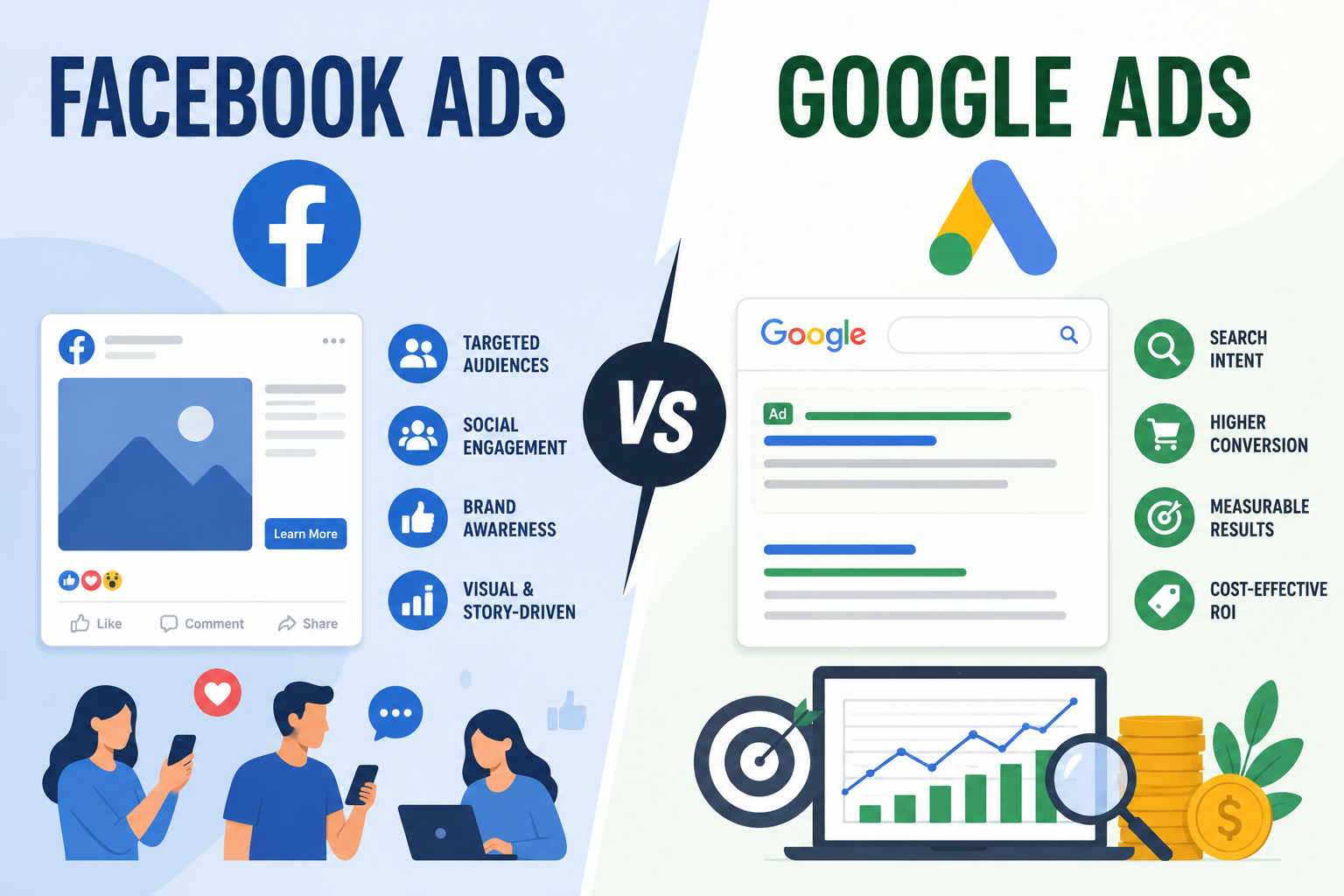
The short version: Google Ads captures people already searching for what you sell, while Facebook Ads (technically Meta Ads now, though everyone still says "Facebook") reaches people who weren't looking for you yet but fit the profile of someone who should be. Both can work brilliantly. Both can also burn through a budget fast if aimed at the wrong business model. Let's figure out which one — or which combination — actually fits yours.

How Google Ads Actually Works
Google Ads operates on intent. Someone types "emergency plumber near me" or "best CRM for small teams," and your ad appears at the exact moment they're already looking for a solution. You're not creating demand; you're capturing demand that already exists, which is a fundamentally different (and often easier) sales job.
Strengths of Google Ads
- Reaches people actively searching, meaning higher purchase intent per click
- Works exceptionally well for services people search for urgently (plumbers, lawyers, locksmiths)
- Highly measurable, with clear keyword-level performance data
- Effective at every stage of a longer B2B sales cycle, not just impulse purchases
Limitations of Google Ads
- You're limited to people who already know they have the problem and are searching for it
- Competitive keywords can carry a genuinely painful cost-per-click, especially in legal, insurance, and finance
- Doesn't build brand awareness the way a scroll-stopping visual campaign can

How Facebook Ads Actually Works
Facebook Ads operates on interruption, in the friendliest possible sense — someone's scrolling through vacation photos and cat videos, not looking for anything, and your ad shows up anyway because Meta's targeting has decided they're a plausible customer based on demographics, interests, and behavior. This is demand generation rather than demand capture: you're introducing a problem-solution pairing to someone who wasn't actively hunting for either.
Strengths of Facebook Ads
- Exceptional for visually compelling products (retail, fashion, home goods, food)
- Granular audience targeting by interests, behaviors, and lookalike audiences based on existing customers
- Lower cost-per-click in many industries compared to competitive Google keywords
- Strong for building brand awareness and retargeting site visitors who didn't convert the first time
Limitations of Facebook Ads
- Lower purchase intent per click, since people weren't actively searching for a solution
- Ad fatigue sets in faster; creative needs regular refreshing to keep performing
- iOS privacy changes in recent years have made precise tracking and attribution more difficult than it used to be

Facebook Ads vs. Google Ads: Head-to-Head Comparison
| Factor | Google Ads | Facebook Ads |
|---|---|---|
| Core mechanism | Captures existing search intent | Generates demand through interruption |
| Best for | Service businesses, urgent needs, B2B | Visual products, brand awareness, impulse buys |
| Typical purchase intent | High | Lower, but improvable with retargeting |
| Targeting method | Keywords and search terms | Demographics, interests, behaviors |
| Creative demands | Lower (text-based ads) | Higher (visuals, video, frequent refreshes) |
| Typical cost-per-click | Varies widely; can be high in competitive industries | Generally lower, but varies by audience size |
Which Platform Fits Your Business Model?
Rather than asking which platform is objectively stronger, ask which one matches how your customers actually find businesses like yours.
- Choose Google Ads if: your customers actively search for what you offer — local services, B2B software, anything people research before buying, or urgent needs where someone's already typing "near me" into their phone.
- Choose Facebook Ads if: your product is visual, impulse-friendly, or benefits from demonstration — retail, restaurants, fitness, home goods, anything that sells itself the moment someone actually sees it.
- Choose both if: you have the budget to run them in tandem, using Facebook to build awareness and warm up an audience, then Google to capture the demand once people start actively searching for you by name.
A lot of businesses that swear by one platform simply haven't tested the other with real budget behind it. A local HVAC company chasing "AC repair near me" clicks will almost always outperform on Google; that same company running lifestyle-style Facebook creative showing a technician mid-repair might actually do just as well building longer-term brand recognition, even if the immediate conversion numbers look different.
Budget Considerations for US Small Businesses
Cost comparisons between the two platforms get thrown around constantly, but the honest answer is that average CPC figures vary wildly by industry, region, and competition — a national average is about as useful as a national average shoe size. What matters more than the platform's baseline cost is whether the traffic it sends actually converts into revenue for your specific business.
A Practical Starting Budget Approach
For businesses testing either platform for the first time, allocating a modest but real budget (enough to gather statistically meaningful data, not just a token spend) for 4–6 weeks tends to surface clearer signal than smaller, shorter tests. Ending a campaign after three days because it "didn't work" is a bit like judging a restaurant by the parking lot.
Where Retargeting Fits In
Regardless of which platform drives the initial click, retargeting the people who visited your site but didn't convert is often the highest-ROI layer of either strategy. Someone who already looked at your pricing page is a warmer lead than someone who's never heard of you, and both platforms let you build campaigns specifically around that group.
Common Mistakes When Choosing Between Them
Judging Facebook Ads by Google Ads Standards
Expecting Facebook traffic to convert at the same rate as Google search traffic misunderstands what each platform is actually doing. Facebook is closer to a billboard that happens to know your interests; Google is closer to someone raising their hand and asking for help.
Running Generic Creative on Facebook
A text-heavy ad that would work fine on Google often falls flat on Facebook, where scroll-stopping visuals do the heavy lifting. Repurposing the same creative across both platforms without adapting it to each format is one of the most common (and easily fixed) budget leaks we see.
Ignoring the Landing Page
Neither platform can save a landing page that doesn't match the ad's promise or load quickly. A beautifully targeted ad sending traffic to a slow, confusing, or mismatched landing page is money spent convincing someone to bounce. Our guide on crafting high-converting landing pages covers what the destination side of this equation actually needs to look like.
Frequently Asked Questions
Is Facebook Ads or Google Ads cheaper for small businesses?
It depends heavily on your industry and competition. Facebook often has a lower cost-per-click on average, but Google Ads frequently delivers higher purchase intent per click, which can make it more cost-effective per actual sale despite a higher CPC.
Can I run both Facebook Ads and Google Ads at the same time?
Yes, and for many businesses this combination outperforms either platform alone. Facebook builds awareness and warms up an audience; Google captures the resulting demand once people start actively searching for your business or solution.
Which platform is better for a brand-new business with no existing audience?
Google Ads often works faster for brand-new businesses since it captures existing demand rather than requiring you to build brand recognition from zero. Facebook can still work well, but typically needs more creative investment and a longer runway to find its footing.
Do I need professional help to run these campaigns, or can I DIY it?
Both platforms are accessible enough to start on your own, but campaign structure, targeting, and ongoing optimization genuinely affect performance at scale. Many small businesses start DIY and bring in professional management once ad spend reaches a level where inefficiency starts costing real money.
How long before I know if a campaign is actually working?
Most campaigns need at least 4 to 6 weeks of consistent spend and optimization before the data is reliable enough to judge performance. Shorter tests often produce noisy, misleading results that lead businesses to abandon a strategy prematurely.
Get a Strategy Built Around Your Business, Not a Coin Flip
The Facebook Ads vs. Google Ads decision isn't really a decision between two competitors — it's a decision about how your specific customers actually discover businesses like yours, and how much budget you have to test properly. Devtaastic's marketing services build and manage campaigns across both platforms based on what the data says about your specific audience, not a generic playbook applied to every client the same way.
Get a free quote today and let's figure out where your ad dollars will actually work hardest. Request your free quote and stop guessing which platform deserves your budget.