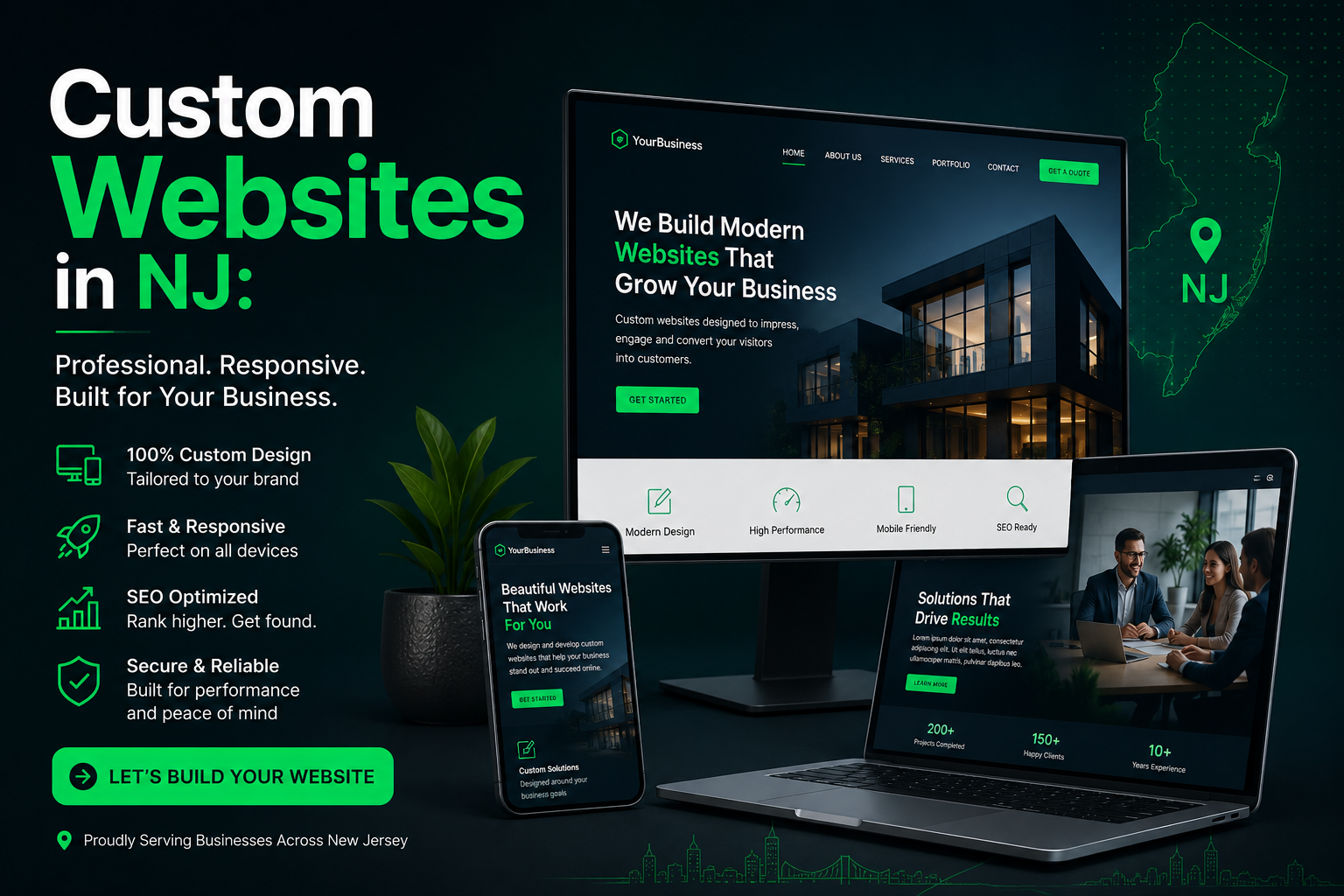
If you've been searching for custom websites in NJ, you've probably already noticed that the price range is, diplomatically speaking, wide. One agency quotes you $800. Another quotes $12,000. Both call it a "custom website," which suggests either the word "custom" has lost all meaning or one of those quotes is going to cause you significant regret. This guide cuts through the noise: what a genuinely custom website delivers, what templates actually cost you in the long run, and how to figure out which one your business actually needs.
What "Custom Website" Actually Means (and What It Doesn't)
The phrase gets used loosely enough that it's worth defining before anything else. A custom website is designed and built specifically for your business — your brand, your audience, your conversion goals. The layout, the code structure, the user flow: none of it existed before your project started.
A template website starts from a pre-built design — a WordPress theme, a Squarespace layout, a Wix template — and swaps in your logo and content. It works. Millions of businesses use them. But you're sharing a structural skeleton with every other site that bought the same template, which is a little less "custom" than the name implies.
The confusion comes from agencies that call a heavily modified template a "custom website." Technically, anything can be called custom if you squint hard enough. What you actually want to ask is: Was this design created specifically for my business, or did it start as someone else's?
The Spectrum Between Template and Fully Custom
| Build Type | Starting Point | Typical Cost (NJ) | Best For |
|---|---|---|---|
| DIY Template | Wix / Squarespace builder | $0–$300/yr | Solopreneurs, early-stage businesses |
| Managed Template | WordPress theme, agency-configured | $800–$3,000 | Local service businesses with basic needs |
| Semi-Custom | Custom design, built on WordPress/Webflow | $3,000–$7,000 | Growing businesses that need brand differentiation |
| Fully Custom | Built from scratch (React, Next.js, etc.) | $7,000–$20,000+ | Businesses where the website is a core revenue tool |
Most NJ small-to-mid-sized businesses land in the semi-custom range. That's not a compromise — it's where the ROI math makes the most sense for the majority of use cases. Devtaastic's NJ web design service covers the full spectrum, but we're going to be direct with you about what you actually need rather than what generates the largest invoice.
What Templates Are Actually Costing NJ Businesses
Template websites aren't bad. They become a problem when the wrong businesses use them, or when the right businesses outgrow them and don't notice. Here's where the costs accumulate — quietly, over time, in ways that don't show up on a single line item.
Page Speed and Core Web Vitals
Most premium WordPress themes ship with 40–60 plugins pre-installed, a stylesheet the size of a small novel, and enough JavaScript to slow a browser to philosophical contemplation. Google measures this through Core Web Vitals — specifically LCP (how fast your main content loads) and INP (how fast it responds to interaction). Sites that fail these metrics rank lower. Lower rankings mean less traffic. Less traffic means fewer leads. The template didn't cost $800. It cost you the leads you didn't get.
Custom-built sites — particularly those built on modern frameworks like React or Next.js — are architecturally faster. There's no plugin bloat, no unused CSS, no theme framework loading features you'll never use.
Conversion Rate
A template's layout was designed to work for a generic business type. Your business isn't generic. The call-to-action placement, the form length, the trust signals, the way the homepage sequences information — all of that either matches how your specific audience makes decisions, or it doesn't. Template designers are optimizing for the median. You're not the median.
Even a 1% improvement in conversion rate on a site that gets 500 visitors a month is five additional leads. At a reasonable close rate, that's real revenue — the kind that makes a $6,000 website investment look modest in retrospect.
Brand Differentiation in a Crowded Market
New Jersey has one of the highest densities of small businesses per capita in the US. If you're a contractor in Morris County, a law firm in Bergen County, or a service business anywhere in the I-95 corridor, you're competing against dozens of businesses with websites that look like yours — because they bought the same theme. A custom design is the only way to look like a category of one rather than one of many.
What You Actually Get with a Custom Website
Custom websites are sold on aesthetics, but the real value is structural. Here's what a properly built custom site delivers that templates structurally cannot.
Architecture Built Around Your Goals
Every decision in a custom build — page structure, navigation, content hierarchy, internal linking — is made in service of a specific outcome: leads, bookings, purchases, quote requests. The site is engineered to move visitors toward a decision, not to display information and hope for the best.
A good agency starts with questions that have nothing to do with design: What does a converted visitor do? Where do your best customers come from? What objections do people have before they contact you? The website design follows from those answers. If an agency leads with portfolio samples before they've asked about your business model, run. Or at minimum, walk briskly.
SEO That Isn't Fighting the Theme
Custom sites give developers full control over the HTML structure, schema markup, page speed optimization, and technical SEO implementation. On a template site, you're often working around the theme's decisions — adding plugins to patch problems the theme created, compromising on structured data because the theme won't let you touch the header. A custom build has none of that overhead. SEO on a custom site is cleaner, faster to implement, and easier to maintain.
Integrations That Actually Work
If your business runs on a CRM, a scheduling tool, a quoting system, or a custom internal workflow, a custom website can integrate with it properly — not through a plugin that sort-of works most of the time and breaks on plugin update days. This matters more than it sounds for NJ service businesses that have grown past the "contact form to email" stage of operations.
Ownership and Portability
When you build on a proprietary platform (Wix, Squarespace, some hosted WordPress setups), your website lives inside someone else's ecosystem. Moving it means rebuilding it. A custom-built site — especially one built on React or a headless architecture — is yours. The code travels with you. That's worth something, particularly if you ever want to switch agencies, hosting providers, or CMS platforms without starting from zero.
How to Decide: Custom vs. Template for Your NJ Business
This isn't a one-size answer. Use this decision framework:
Choose a Template If:
- Your website is informational and not a primary lead source
- You're pre-revenue or early-stage and need to validate the business before investing in infrastructure
- You need something live within two weeks
- Your monthly web traffic is under 500 visitors and you're not running paid ads
Choose Semi-Custom or Fully Custom If:
- Your website is the main channel for inbound leads
- You're running Google Ads or investing in SEO — every wasted click costs you money
- You need specific functionality (quoting, booking, e-commerce, member portals)
- You've outgrown a template and conversions have plateaued
- You're in a competitive NJ market where differentiation is the only play
The Questions That Actually Decide It
| Question | Template Lean | Custom Lean |
|---|---|---|
| How much of your revenue depends on web leads? | Less than 30% | More than 30% |
| Are you running paid traffic to the site? | No | Yes |
| Does your business have unique functionality needs? | No | Yes |
| Is your current site underperforming on speed or conversions? | No | Yes |
| Are you in a market with significant online competition? | Low competition | High competition |
What the Custom Website Process Looks Like
Understanding the process helps you evaluate agencies, ask better questions, and avoid the ones who skip the parts that matter.
Phase 1: Discovery (Week 1–2)
A legitimate custom build starts with a discovery phase — understanding your business, your audience, your competitors, and your conversion goals. Any agency that skips this and goes straight to mockups is designing for themselves, not for your customers.
Phase 2: Design (Week 2–4)
Wireframes first, visuals second. The layout and information hierarchy should be validated before anyone spends time making it look beautiful. This is where the conversion logic gets built into the structure — button placement, CTA sequencing, trust signal positioning.
Phase 3: Development (Week 3–8)
The design becomes a working website. On a custom React or Next.js build, this is where performance optimization happens at the code level — not as a plugin bolted on at the end. Next.js development in particular produces sites with exceptionally fast load times, which matters for both user experience and SEO.
Phase 4: QA and Launch (Week 7–10)
Cross-browser testing, mobile responsiveness, form functionality, page speed audit, schema validation, and redirect setup. Any agency that treats launch as the finish line rather than the beginning is selling you a one-night stand when you needed a long-term relationship.
Phase 5: Post-Launch Support
Get clarity on this before you sign anything. Who owns the code? Who handles security updates? What's the support arrangement for the first 30–90 days? Maintenance and support terms should be explicit, not implied.
What to Watch Out For When Hiring in NJ
New Jersey has no shortage of web design agencies, freelancers, and firms that are somewhere in between. Here's the short list of things that should give you pause:
- No discovery phase. If they're quoting you before they've understood your business, the quote is a guess.
- Vague ownership terms. You should own the code, the domain, and the hosting accounts. In writing.
- Portfolio with no results. Pretty screenshots are not evidence of performance. Ask what happened to traffic or conversions after launch.
- Outsourced builds with no disclosure. Some NJ agencies are sales operations fronting offshore production. Not inherently bad, but you should know, and the quality control should be explicit.
- "SEO included" with no specifics. On-page optimization is table stakes. Ask what "included SEO" actually means — schema markup, Core Web Vitals optimization, internal linking strategy, or just an H1 tag.
The full NJ web design hiring guide covers this in detail, including the specific questions to ask before signing any contract.
Frequently Asked Questions
How much does a custom website cost in New Jersey?
Custom website costs in NJ typically range from $3,000 to $15,000 for small-to-mid-sized businesses, depending on the number of pages, functionality required, and the agency you hire. E-commerce or web app projects run higher. Agencies in NJ generally price higher than offshore teams, but the gap narrows when you factor in revision cycles and communication overhead with distant vendors.
What is the difference between a custom website and a template website?
A template website uses a pre-built design that you customize with your content and branding. A custom website is designed and built from scratch for your specific business goals, brand, and audience. Custom sites load faster, convert better, and give you full control over functionality — but they cost more upfront.
Is a custom website worth it for a small NJ business?
It depends on how much your website is expected to do. If you're a local service business generating most leads through referrals, a well-configured template may be sufficient. If you rely on organic search, paid ads, or need specific functionality like booking, quoting, or e-commerce — a custom website typically pays for itself through better conversion rates and lower bounce rates.
How long does it take to build a custom website in NJ?
A typical custom website project runs 4 to 10 weeks from kickoff to launch, depending on scope, client feedback speed, and content readiness. Complex builds with integrations or e-commerce functionality take longer. Agencies that skip the discovery phase tend to deliver faster but revise longer — which is a trade-off, not a feature.
What should I look for when hiring a custom web design agency in NJ?
Look for: a portfolio with work in your industry or at your business size, clear ownership of code and assets after delivery, a defined revision process, post-launch support terms, and transparent pricing. Avoid agencies that can't explain their tech stack or won't tell you who actually builds the site.
Ready to Talk About a Custom Website for Your NJ Business?
Devtaastic builds custom websites for NJ businesses that need more than a digital brochure. We cover the full process — strategy, design, development, and post-launch support — with a team that's built enough sites to know where corners get cut and why they always cost more later.
If you're evaluating agencies or just trying to understand what your project would actually cost, get a free quote. No pitch deck, no pressure — just a straight conversation about what you need and what it takes to build it right.
You can also browse our portfolio and our full range of web development services to get a sense of what we build and how.